
Enjoying this article?Add Techodom as a preferred source on Google and see our tech news, reviews, and how-to guides more often in your search results.
Last winter, my neighbor bragged about scoring a $450 online treadmill deal. Eight months later, I helped him haul its burned-out carcass up a narrow basement staircase. Its 1.75 peak horsepower motor cooked itself during 5 mph jogs, and its speed controller tripped his basement breaker every Tuesday.
Most treadmill spec sheets hide weak parts behind inflated numbers. Manufacturers advertise momentary surge power instead of sustained motor output, bury $468 annual software fees in small footnotes [12], and skip the math on basement ceilings or second-floor vibration.
If you want a quiet, stable machine that stays out of the landfill, you need hard pass-or-fail numbers before you compare brands. Use these 12 mechanical, spatial, electrical, and financial benchmarks to filter your shortlist before you spend a dime. Before you compare motors or belts, pick the machine category that matches your daily pace.
1. Treadmill category, walking pad vs. folding vs. non-folding
Home treadmills split into four distinct mechanical builds, and buying the wrong category guarantees frustration. Shoppers often buy an under-desk walking pad hoping to jog on rainy days, only to smell burning electronics within six weeks. In 2026, the U.S. Consumer Product Safety Commission (CPSC) warned consumers to stop using specific budget walking pads immediately after logging 201 reports of erratic speed, abrupt stops, and overheating hazards [15].
| Category | Typical price | Max speed | Footprint | Best home use case |
|---|---|---|---|---|
| Under-desk walking pad | $200 to $600 | 3.5 to 4.0 mph | 50 x 22 in | Light desk steps under 60 minutes |
| Folding motorized treadmill | $900 to $2,500 | 10 to 12 mph | 75 x 35 in | Shared spare rooms and daily running |
| Non-folding motorized treadmill | $1,800 to $4,500+ | 12 to 12.5 mph | 80 x 37 in | Dedicated home gyms and heavy marathoners |
| Curved manual slat treadmill | $1,200 to $5,000 | Unlimited sprint | 68 x 33 in | Unpowered garages and high-intensity interval training (HIIT) |
A folding treadmill uses a hydraulic gas shock (a slow-lowering cylinder) to lift the deck upright between workouts, and that design cuts your idle floor footprint almost in half [16].
That hinge introduces a slight mechanical trade-off. Folding frames flex slightly more under heavy sprinters and usually cap user weight 50 pounds lower than rigid, welded non-folding frames [16].
Curved manual treadmills skip the electric motor altogether, which solves outlet headaches in detached spaces, though their rubberized slats exceed 75 decibels and force your hamstrings to pull every step without cruise control [3].
Grab a tape measure next so your chosen frame fits your room and clears your ceiling.
2. Room footprint, safety clearance, and ceiling height math
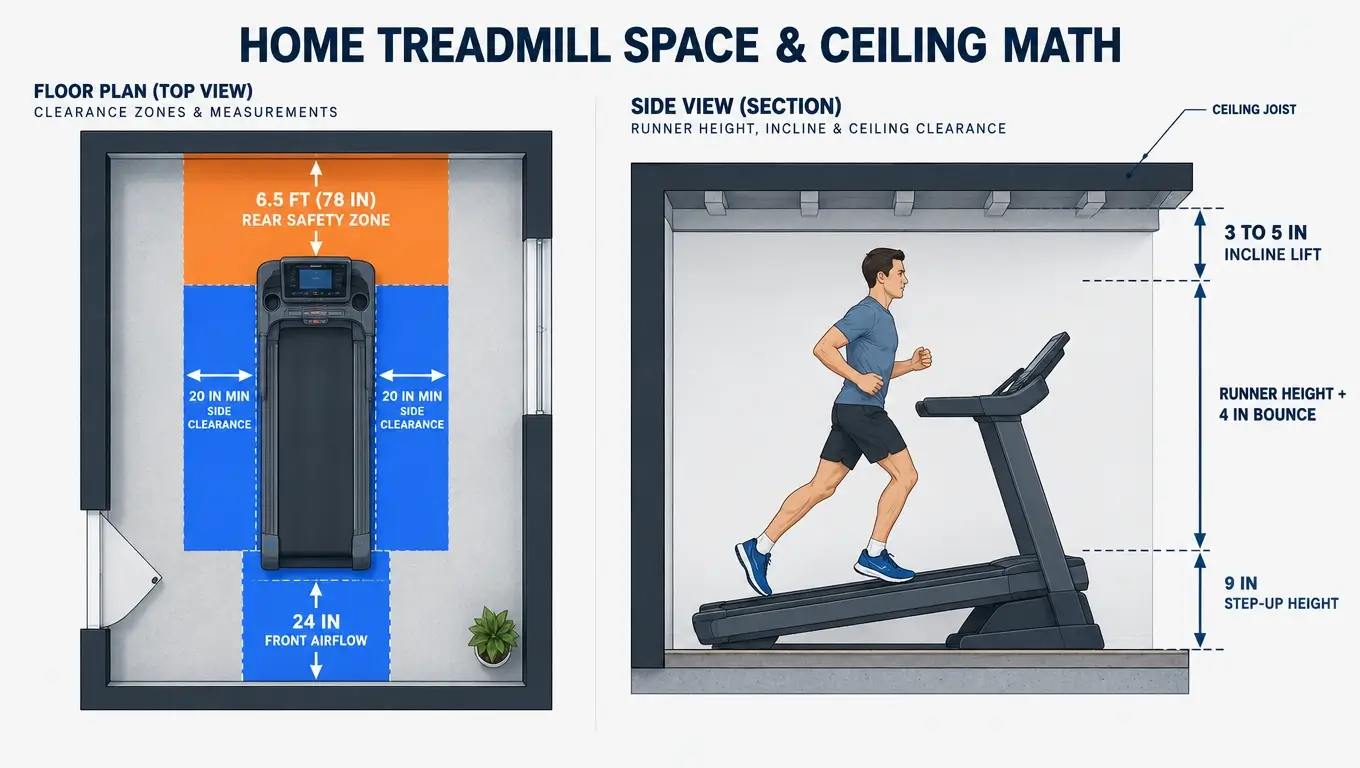
A full-sized home treadmill measures roughly 75 to 80 inches long and 35 to 38 inches wide [18].
Never wedge that frame tight into a corner. American Society for Testing and Materials (ASTM) safety standard F2115-12 specifies at least 78 inches (6.5 feet) of unobstructed emergency dismount clearance directly behind the moving belt and at least 19.7 inches on each side [1].
Leave 24 inches at the front nose too so the motor hood vents heat properly [3].
Pushing the back of a treadmill close to a concrete wall or weight rack turns a simple foot slip into a pinning injury.
Have you measured your basement joists yet? Ceiling clearance ruins more basement gym plans than floor width ever does. Step-up height = the vertical distance from your floor to the top of the running belt, which ranges between 7.5 inches on low-profile decks and 11 inches on thick cushioned frames [18].
Add your height in running shoes, add 4 inches for natural vertical running bounce, and add 3 to 5 inches if you train at a 12% to 15% incline.
| Runner height | Deck step-up height | Flat running clearance needed | 12% incline clearance needed | Fits 7-foot (84 in) ceiling? |
|---|---|---|---|---|
| 5 ft 4 in (64 in) | 8 in | 77 in | 81 in | Yes (tight at max incline) |
| 5 ft 9 in (69 in) | 9 in | 83 in | 87 in | Flat only, no steep incline |
| 6 ft 0 in (72 in) | 9.5 in | 86.5 in | 90.5 in | No (requires 8-foot ceiling) |
| 6 ft 3 in (75 in) | 10 in | 90 in | 94 in | No (requires 8-foot ceiling) |
Check the folded vertical height on spec sheets as well, because a 60-inch deck tilted upright can stand 68 to 72 inches tall and scrape low basement ductwork [16]. Passing the tape-measure test still is not enough if the wall outlet in that room trips mid-run.
3. Home electrical circuits, GFCI traps, and garage climate limits
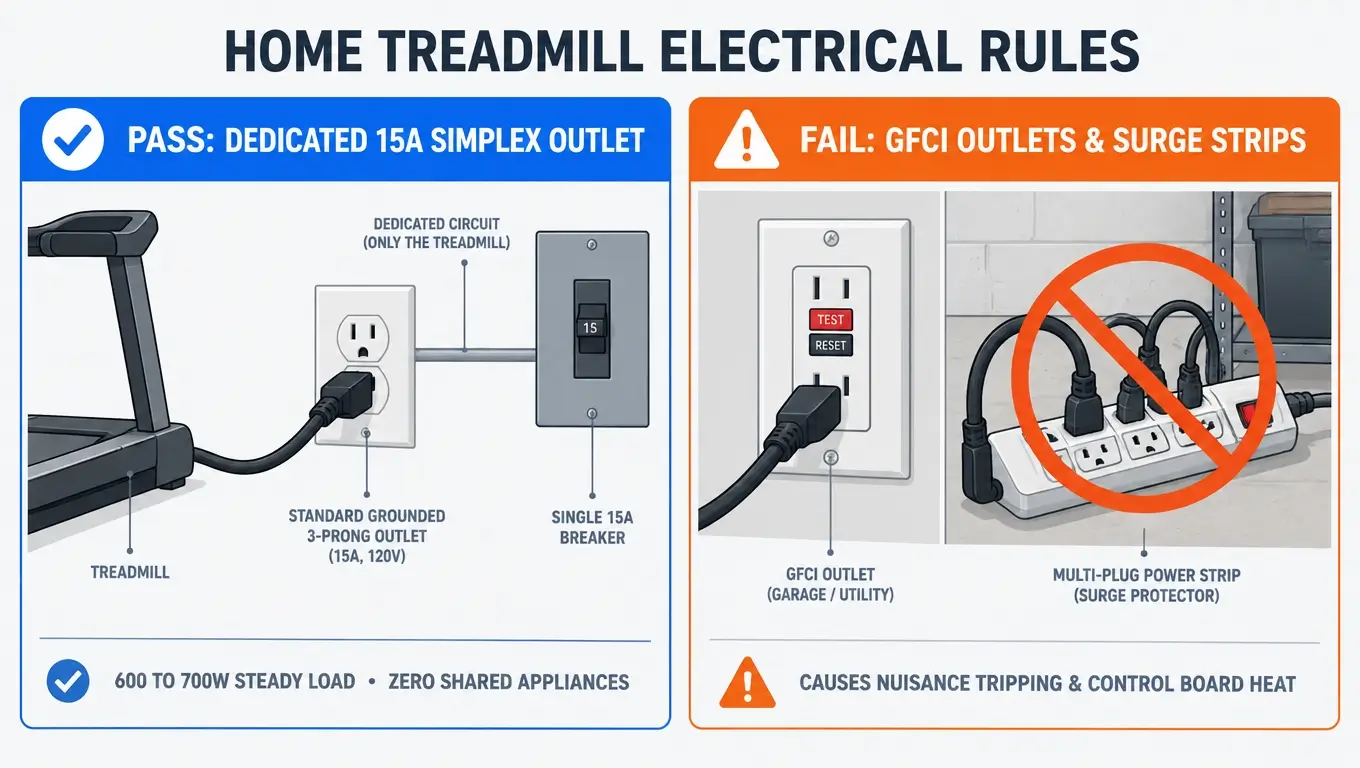
Almost every big-box buying guide ignores residential wiring, and service technicians make a living off that silence. A motorized treadmill pulls 600 to 700 watts during steady cruising [3], and heavy footstrikes spike current draw higher on every step.
Manufacturers require a dedicated 15-amp circuit (or 20-amp for commercial-grade machines) that shares zero load with space heaters, Peloton bikes, deep freezers, or laser printers [2] [3].
NEVER plug a treadmill into an extension cord or a multi-outlet surge strip, because voltage drops overheat the motor control board within months [2].
“Wait, my unfinished basement and garage only have GFCI outlets, so what do I do?”
Hire a licensed electrician to check whether local code permits a dedicated single-appliance receptacle on a standard breaker, or buy a self-powered manual treadmill. Watch temperature and humidity in that garage too. Brands including NordicTrack warn that placing equipment in an uninsulated garage puts your warranty coverage at risk [4].
Damp winter air, road salt dust, and freezing mornings condense water droplets across circuit boards, leaving you with a repair bill that warranty reps routinely reject [4] [6]. With your room wiring sorted, turn straight to the motor spec.
4. Motor power, continuous horsepower by pace and weight
Ignore “peak horsepower” or “impulse horsepower” badges on budget listings.
Peak horsepower = the maximum output a motor hits for two seconds in a lab right before melting its copper coils. You only care about continuous horsepower (CHP), which measures the steady power a motor holds through an entire 60-minute session without overheating [5] [6].
If a product page hides the CHP number, close the tab [6].
Match your minimum continuous horsepower to the heaviest person in your house and their fastest regular pace. Garage Gym Reviews recommends at least 2.5 CHP for general home use and 3.0 CHP or higher for regular running [5].
Published 2026 sizing guidelines also add 0.5 CHP whenever a user weighs over 200 pounds (90 kg), because heavier footfalls create higher belt drag on every step [3] [6].
| Primary workout style | User under 180 lbs | User 180 to 230 lbs | User over 230 lbs or multi-user home |
|---|---|---|---|
| Daily walking (2 to 4 mph) | 2.0 to 2.5 CHP | 2.5 CHP | 3.0 CHP |
| Light jogging (4 to 6 mph) | 2.5 to 3.0 CHP | 3.0 CHP | 3.25 to 3.5 CHP |
| Regular running & HIIT (6+ mph) | 3.0 CHP | 3.5 CHP | 3.5 to 4.0+ CHP (AC motor preferred) |
Check the motor design as well. Most home treadmills use direct-current (DC) motors; cheap brushed DC motors rely on small carbon blocks that wear down over time, whereas newer brushless DC motors use magnets to run quieter and cooler. High-end $2,500+ machines step up to alternating-current (AC) commercial motors, the heavy-duty kind used in health clubs that run for hours without overheating [18]. Yet even a health-club motor cannot fix a belt that is too short for your legs.
5. Belt length and width plus hidden ergonomic flaws
Shoppers underestimate how much their stride stretches once fatigue sets in at mile four. Belt length and width determine whether you run relaxed or stare nervously at your feet. Standard sizing rules call for at least a 50-inch belt for dedicated walkers, a 55-inch belt for average-height runners, and a full 60-inch belt for any runner standing 6 feet or taller [6] [7].
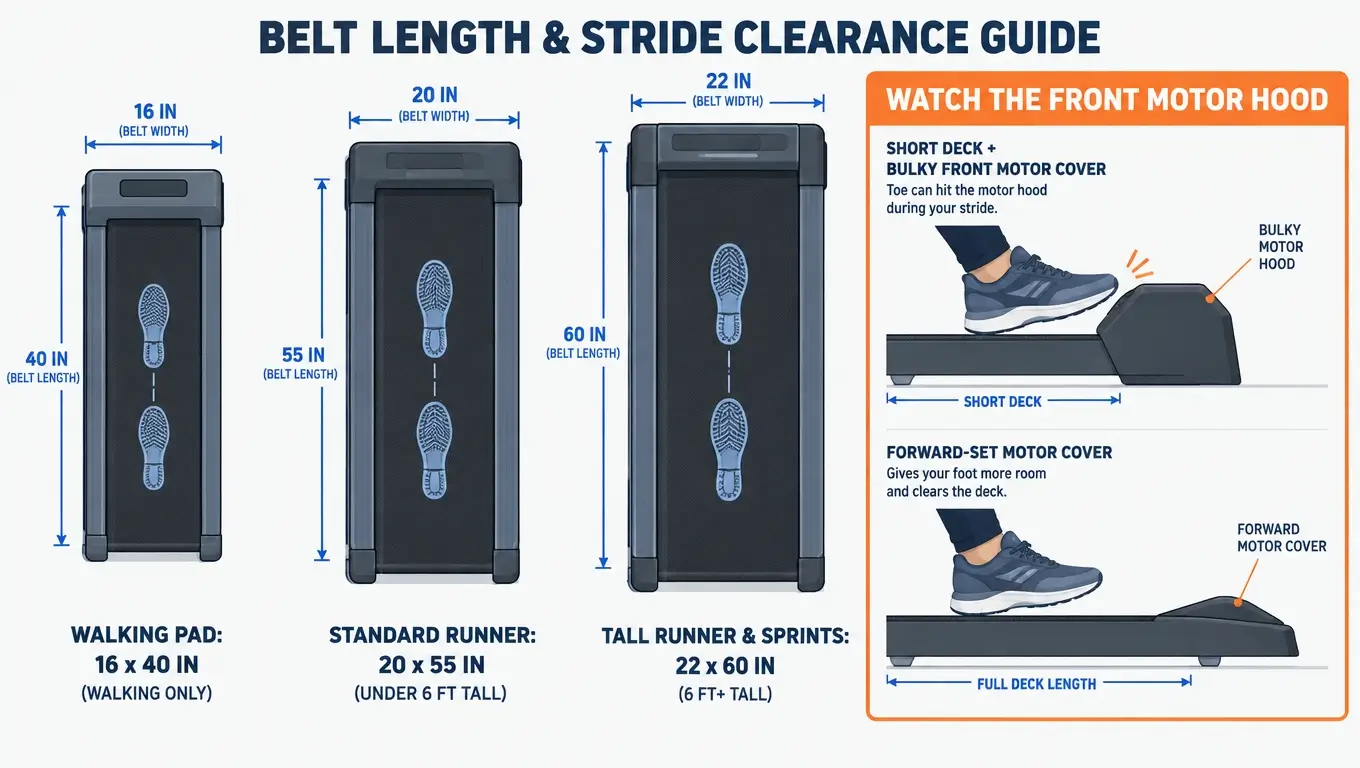
Width matters just as much for comfort. Narrow 16-to-18-inch belts force a tightrope gait and leave zero margin when you reach sideways for a towel. Aim for a 20-inch belt width as your baseline and step up to 22 inches if you have broad shoulders or run fast intervals [6] [18].
Watch for a sneaky design flaw that never shows up in dimension tables. Many compact treadmills bolt a tall plastic motor hood right onto the front five inches of the running surface [18].
Wirecutter testers flagged multiple popular machines where runners kicked that plastic cover or tripped on front kickplates whenever they ran close to the console [18].
Look at side-profile photos to confirm the motor hood sits forward of the front roller rather than eating into your usable 60-inch stride zone. Beneath that belt sit four mechanical parts that separate ten-year workhorses from disposable junk.
6. Rollers, belt ply, weight buffers, and shock absorption cushioning
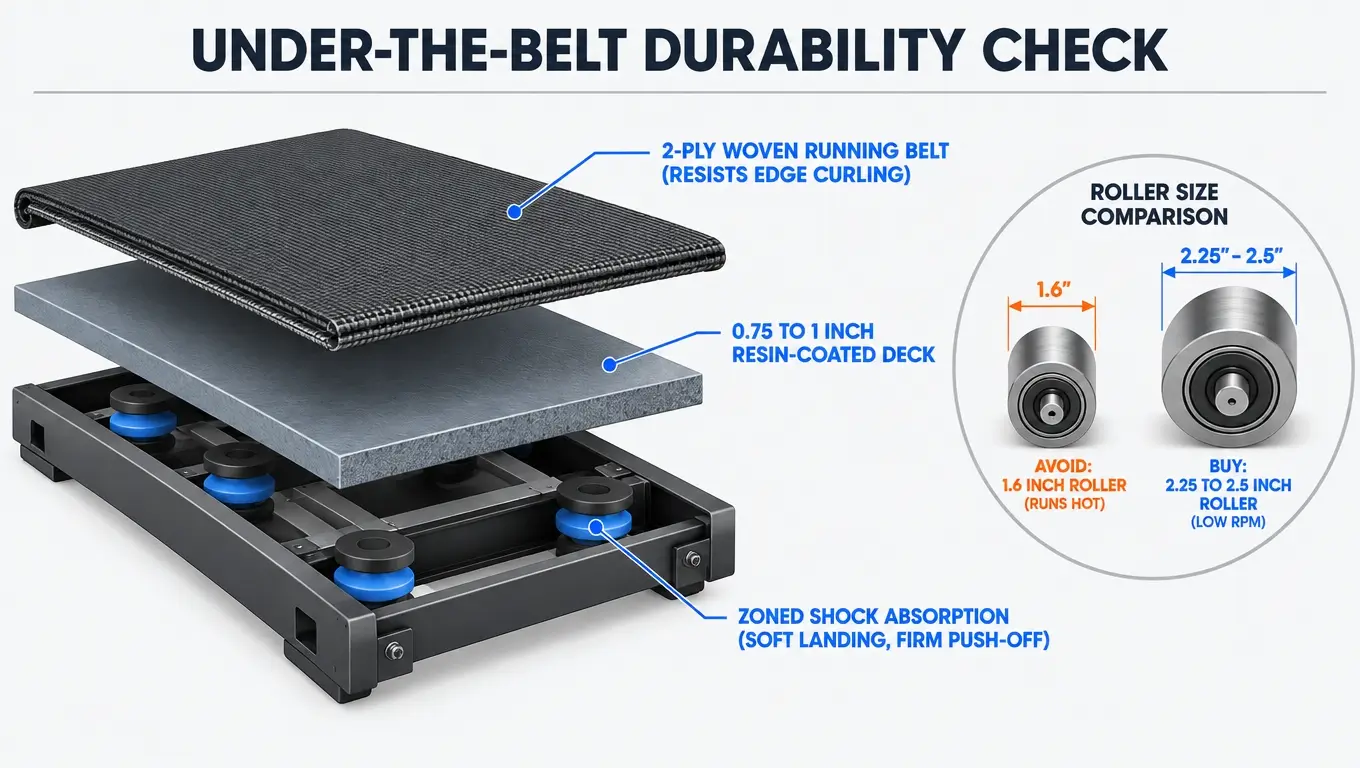
Want to spot cost-cutting in five seconds? Read the roller diameter line in the technical specs. Rollers are the steel cylinders at the front and back of the frame that tension and spin your belt, and TreadmillReviews.net notes they are the most commonly damaged component on home machines [7].
Budget treadmills use skinny 1.6-inch rollers that spin fast, trap heat, and burn out bearings. Insist on 2.25-inch to 2.5-inch steel rollers, which grip more belt surface area at lower speeds and extend belt life by years [7].
Pair large rollers with a 2-ply running belt (two woven fabric layers fused together for strength) gliding over a 0.75-inch to 1-inch wooden deck sealed with a slick, low-friction resin coating. Thin single-ply belts curl along the edges and wear out fast [7].
Apply a strict 50-pound reality tax to maximum user weight ratings too. Verywell Fit advises subtracting 50 pounds from any manufacturer’s stated weight cap so your body weight does not strain the motor on impact. If you weigh 220 pounds, skip 250-pound frames and shop 300-pound-rated decks minimum [8].
Evaluate shock absorption cushioning with realistic expectations. A 2020 meta-analysis of 33 studies by Bas Van Hooren and colleagues in Sports Medicine found that motorized treadmill running matches outdoor running stride mechanics closely, while cushioned treadmill decks reduce peak impact stress on your shinbone [9].
Softer rubber-cushioned decks save sore knees during daily 4 mph walks. Too much trampoline bounce backfires for road marathoners, though, because squishy foam steals push-off energy and works your Achilles tendon harder than asphalt (Ed. note: I always pick zoned decks that cushion heel strikes up front while keeping the rear push-off zone firm). Speed and incline motors separate good frames from sluggish ones next.
7. Speed, incline, decline, and interval ramp-up lag
A 10 mph top speed equals a 6-minute mile, which satisfies steady distance runs, while 12 mph (a 5-minute mile) gives sprinters real headroom [8] [18].
Power incline is even more valuable for joint-friendly conditioning. A 2012 biomechanics study by Jason Franz and Rodger Kram in Gait & Posture showed that walking uphill at a 9% grade increased hip, knee, and ankle muscle activation substantially compared to flat walking, including a 635% jump in hip extensor effort at slow speeds [10].
That means a 10% to 15% power incline burns serious energy at 3.5 mph without pounding your knees. Adding a -3% power decline trains your front thigh muscles to absorb downhill braking forces if you race hilly outdoor courses [16] [18].
Skip manual pin-adjusted inclines completely; nobody hops off a moving belt mid-workout to move pins under a sweaty frame [7].
Do you run 30-second HIIT intervals or Tabata sprints? Standard spec tables hide acceleration lag. Runner’s World lab tests measure exact transition times from 6 mph to 12 mph, because sluggish motors take 15+ seconds to wind up and eat half your sprint interval before you reach target pace [11].
Models built for intervals (such as Horizon’s rapid-sync dial decks) jump speeds in roughly 8 seconds or less and place 1-through-12 quick-jump keys right at waist level so you never stab a tiny screen arrow at full stride [11].
Those speed buttons live on the console, where treadmill brands hide their priciest recurring trap.
8. Console tech and the $40 monthly subscription trap
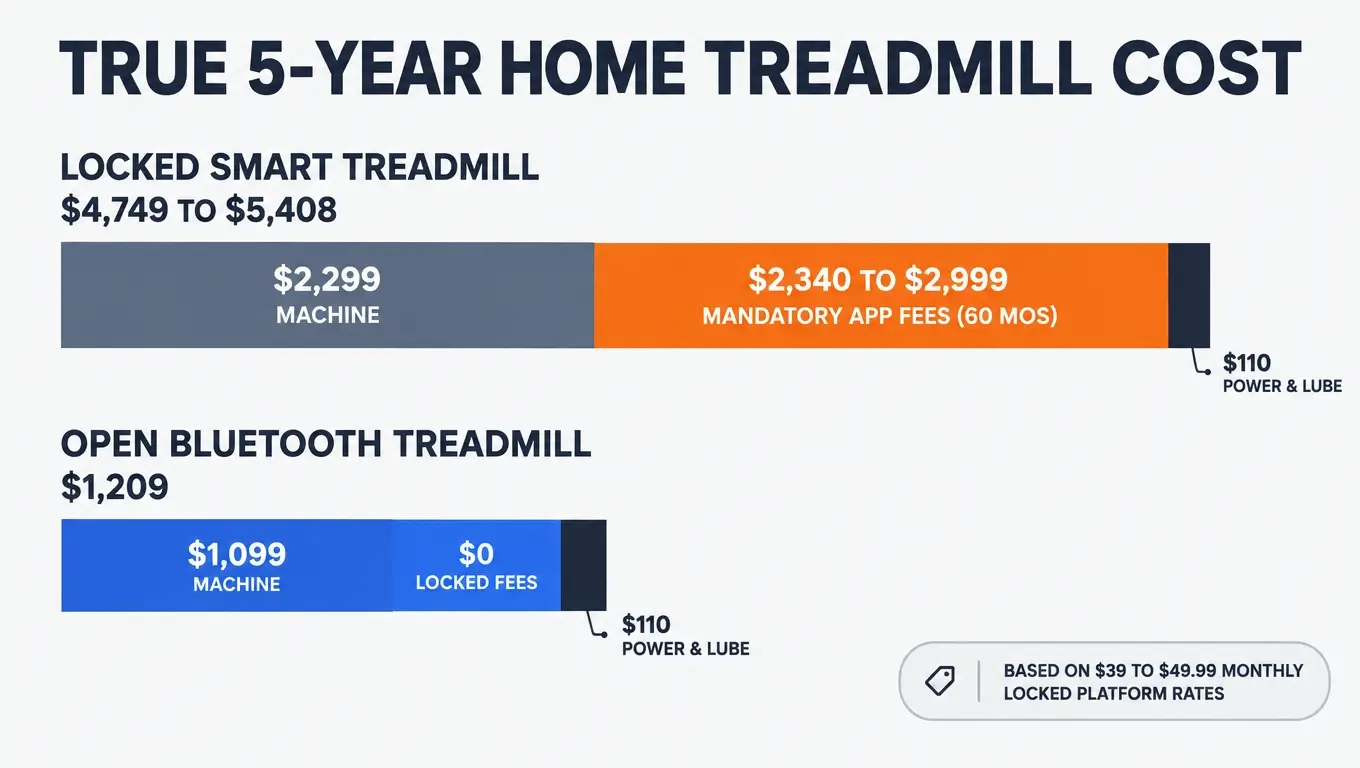
“If I stop paying the monthly app fee, does my $2,300 smart treadmill turn into a brick?” Not quite a brick, though it comes close to an overpriced manual speedometer. Consumer Reports divides modern consoles into locked single-platform screens, open multi-app Bluetooth machines, and self-contained consoles [16].
Locked machines like NordicTrack and ProForm require an iFIT Pro membership at $39 per month ($396 billed annually) to run built-in touchscreen classes and automatic hill adjustments [12] [18], while Peloton’s Tread line requires a $49.99 monthly All-Access Membership [13].
Cancel those plans and your crisp 16-to-24-inch HD display drops you onto a plain manual track, locks out custom workout creation, and blocks built-in video apps on most models [16].
| 5-year cost item | Locked smart treadmill (e.g., iFIT / Peloton tier) | Open Bluetooth treadmill + your own tablet |
|---|---|---|
| Upfront machine price | $2,299 | $1,099 |
| 60 months of mandatory app fees | $2,340 to $2,999 [12] [13] | $0 mandatory ($779 optional app) |
| Silicone belt lube & home electricity | $110 [3] | $110 [3] |
| True 5-year ownership total | $4,749 to $5,408 | $1,209 (or $1,988 with optional app) |
A $2,340 to $2,999 software bill over five years shocked me the first time I ran the math for a client [12] [13]. Unless you genuinely love trainer-controlled terrain videos, look for open Bluetooth consoles from brands like Horizon, Sole, or BowFlex [16] [18].
You rest your own iPad on the ledge, pair optional apps like Zwift or Peloton App ($12.99 per month) [13], and swap out the tablet in four years instead of scrapping a sluggish built-in screen. Even a subscription-free console sits idle if 6 a.m. miles wake your kids or shake your downstairs neighbor’s ceiling.
9. Home noise levels, upstairs floors, and child safety
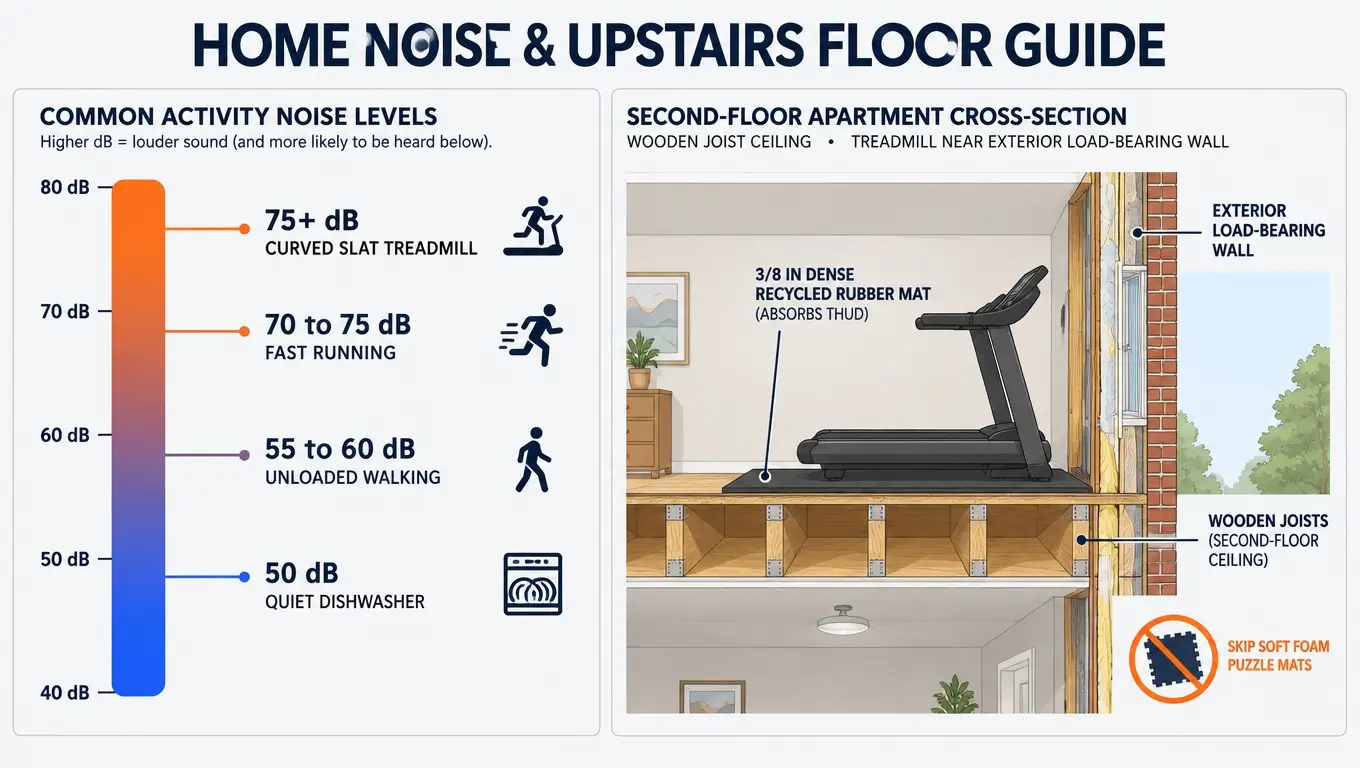
Treat advertised decibel ratings with skepticism. Quiet home treadmills hum along at 50 to 60 decibels during light unloaded operation (normal conversation volume), while high-speed running pushes noise past 70 to 75 decibels (loud vacuum cleaner territory) [3]. Worse, airborne sound is only half the headache in an apartment or two-story house.
Every running footstrike sends low-frequency thudding straight down into wooden floor beams. Soft foam puzzle mats squish flat under a heavy treadmill and let that thud travel into the ceiling below. If you live in an upstairs apartment, stick to brisk incline walking (3.0 to 3.8 mph), place the treadmill along a load-bearing exterior wall, and set it on a dense 3/8-inch recycled-rubber equipment mat [3] [5].
Save fast 8 mph runs for ground-floor slabs or basements.
Take child and pet protection seriously before delivery day. In 2021, the CPSC and Peloton recalled the Tread+ after 72 reports of adults, children, pets, and objects getting pulled beneath the rear of the slat deck, including one child’s death, which led to a $19 million CPSC civil penalty in 2023 [14].
Demand three home safety features on any machine: a magnetic safety tether clip that kills belt power when pulled, a rear roller guard that blocks fingers or paws from catching under the belt, and a console passcode lock (Ed. note: pull the magnet key off the console and hang it on a high wall hook after every single run) [3].
Heavy, safe frames create one logistical catch on delivery day.
10. Delivery logistics, stairwells, warranties, and return fine print
Quality running treadmills weigh 240 to 330 pounds inside cardboard freight boxes over seven feet long [16] [18].
Free “curbside” or “threshold” shipping means a freight driver drops that pallet at the end of your driveway or just inside your garage door [16].
Measure your narrowest hallway, doorway (often 30 inches clear), and any 90-degree basement stair landing before ordering. Paying $199 to $299 for white-glove room-of-choice assembly pays for itself the moment two pros carry the deck upstairs, route the fragile console data wire through the upright mast without pinching it, and haul away 40 pounds of pallets.
Read the warranty sheet like a mechanic, because warranty length exposes what the factory actually thinks of its own steel and electronics [8].
Skip anything under $600 carrying a 90-day warranty [7]. For any home treadmill over $1,000, hold the brand to four minimum coverage bars [8].
- 10 years to lifetime on the structural steel frame [8] [18]
- 5 years to lifetime on the drive motor [8] [18]
- 2 to 3 years minimum on parts, deck, and electronics [8] [18]
- 1 to 2 years on in-home labor so a vetted technician visits your house [8]
Verify return fine print before clicking checkout too. Consumer Reports notes that 30-day home trials frequently deduct $150 to $250 in return freight fees plus a 10% to 15% restocking penalty if you discard the giant original shipping carton [16].
Knowing those logistics lets you match your real budget to the right price bracket and claim tax-free savings.
11. Price tiers, HSA/FSA tax savings, and used inspection checks
Home treadmill pricing follows predictable mechanical jumps in 2026 [6].
Under $600 buys light walking pads with short warranties [7]; $700 to $1,200 buys entry folding machines (like the Horizon T101 or 7.0 AT class) suited for daily walkers and 3-mile joggers [6] [11]; $1,300 to $2,200 hits the durability sweet spot with 3.0 to 3.5 CHP motors, 22-by-60-inch belts, and 12% to 15% power incline for serious runners [18]; and $2,300 to $4,500+ buys commercial AC motors, slat belts, and decline training [16] [18].
If your budget tops out at $350, skip flimsy new walking pads and inspect a five-year-old Sole, Spirit, or True treadmill on Facebook Marketplace instead. Run three two-minute checks in the seller’s garage before handing over cash.
- Search the model’s button combo beforehand to open the console’s diagnostic menu and check lifetime miles and hours (walk away if a home DC motor shows over 1,500 hours).
- Unplug the cord and slide your fingers under the center of the belt; walk away if you feel deep grooves, cracked deck coating, or piles of black rubber dust.
- Plug it in, set speed to 2.5 mph, grab the handrails, and stomp firmly on the belt; if the belt hesitates or slips under your weight, the motor or drive belt is worn out.
Whether you buy used locally or visit a specialty fitness showroom, run one final 10-minute physical audit before you pay.
12. Your 10-minute pre-purchase test and next steps
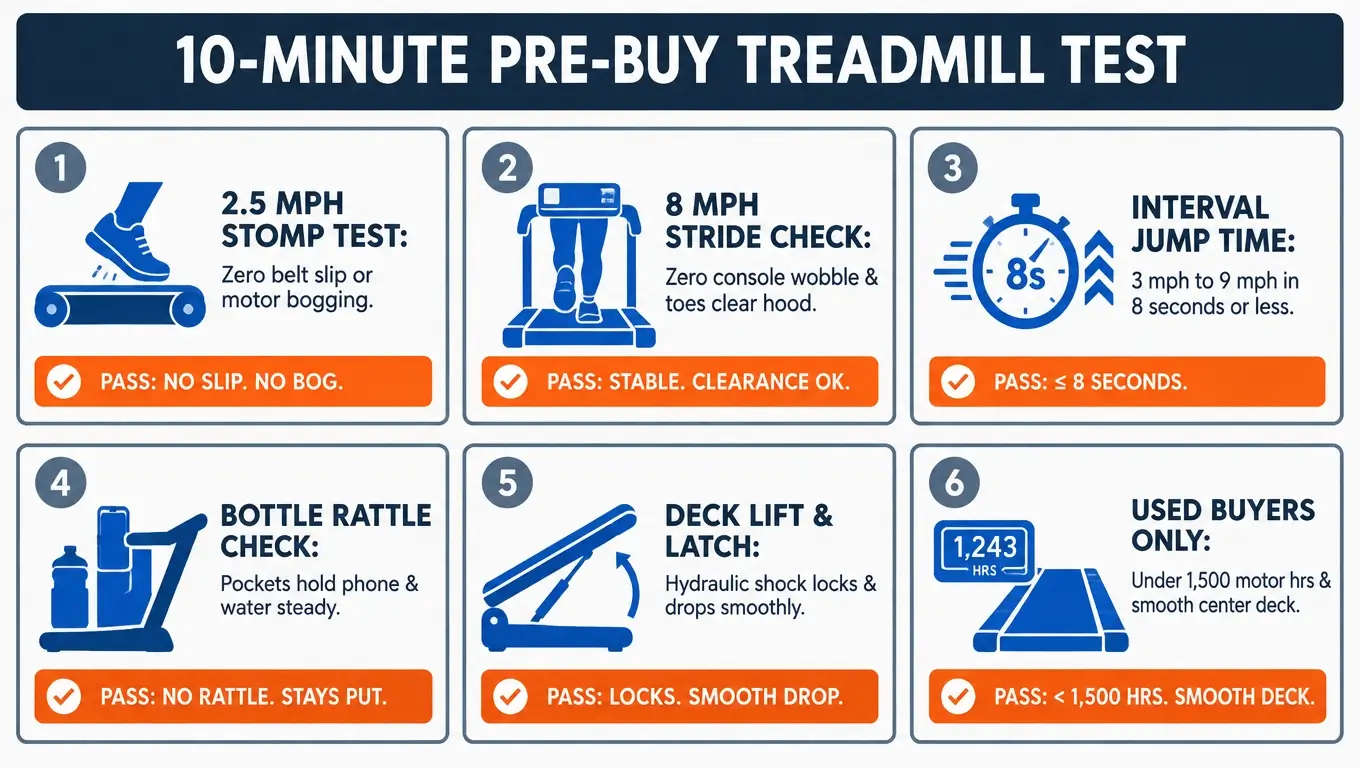
Knowing what to look for when buying a treadmill for home turns confusing spec tables into a fast elimination game. Before you pull out a credit card, lace up your regular running shoes and spend at least 10 minutes testing your top two contenders at a local fitness dealer [8], or verify these five points inside independent teardown videos.
- Start with a slow 2.5 mph walk for two minutes so you can feel whether the belt glides smoothly or stutters underfoot.
- Push the pace to 8 mph for five minutes, watch the upright console masts for wobble, and confirm your toes never clip the front motor cover [8] [18].
- Stopwatch a speed jump from 3 mph to 9 mph; intervals feel crisp when the motor hits top speed in 8 seconds or less [11].
- Set your phone and a full water bottle inside the console pockets during a brisk run to catch annoying plastic rattles early [18].
- Lift and lower the folding deck yourself to check heavy frame weight and floor latch clearance [8].
Do not buy the first holiday sale banner you see today. Write down your room dimensions, ceiling height minus step-up height, dedicated outlet location, and minimum CHP number from this guide. Use those four filters to shortlist two or three subscription-friendly models in your price tier, then compare independent hands-on reviews or book a 10-minute showroom test run this week.
6 home treadmills that actually pass these specs in 2026
Run the current home market through all 12 rules above and roughly four out of five machines fail on short belts, weak rollers, 90-day warranties, or hidden software lock-ins. If you want a ready-made shortlist to test at a local showroom or compare side by side, these six models clear our mechanical and warranty bars for their respective budgets.

Most treadmills near $1,000 cut the deck down to 55 inches or hide workouts behind a paywall.
The Horizon 7.0 AT gives you a full 20-by-60-inch running surface, a 3.0 CHP motor, a 15% power incline, and a lifetime frame and motor warranty [11] [19].
Physical thumb-dial rollers on the front handles shift speed and grade in seconds during interval sprints, and open Bluetooth pairs cleanly with your own tablet [11].
Skip it if you weigh over 220 pounds and run daily; step up to its heavier 318-pound sibling, the Horizon 7.4 AT, for a 3.5 CHP motor and 22-inch-wide belt.

If you log steady 5-mile runs and hate monthly software bills, shortlist the Sole F80 (or the $1,199 Sole F63 if you weigh under 190 pounds and accept a 20-inch belt width) [20].
The F80 pairs a 3.5 CHP motor with a wide 22-by-60-inch firm deck, a 350-pound weight rating, and a 10.1-inch screen with free screen mirroring and zero mandatory memberships [20].
Skip it only if you run fast 30-second HIIT intervals, because Sole motors ramp speed up and down slower than Horizon or BowFlex decks.

Independent testers at Wirecutter and Runner’s World keep naming the Commercial 1750 their top overall pick for two hardware reasons [11] [18].
Its 22-by-60-inch cushioned deck absorbs joint shock smoothly, and its motor tilts from a 12% climb down to a -3% downhill decline on a lowered step-up frame [18] [21].
Only shortlist this machine if you genuinely plan to keep the $39 monthly iFIT Pro membership active for auto-adjusting trainer runs [12] [18].
The F80 pairs a 3.5 CHP motor with a wide 22-by-60-inch firm deck, a 350-pound weight rating, and a 10.1-inch screen with free screen mirroring and zero mandatory memberships [20].
Skip it only if you run fast 30-second HIIT intervals, because Sole motors ramp speed up and down slower than Horizon or BowFlex decks.

Want a plush 22-by-60-inch running deck and fast interval dials without paying $468 a year in software fees?
Wirecutter’s runner-up pick, the BowFlex T9, runs a 3.5 CHP motor up to a 15% incline, pairs with an Apple
Watch in one tap, and works freely with Zwift, Peloton App, or built-in programs with zero subscription required [18] [22].

Spirit builds old-school 287-pound folding tanks sold primarily through local specialty fitness dealers who service what they sell [16] [23]. Alongside a 3.5 CHP motor, 2.5-inch commercial rollers, and a 375-pound weight limit, the XT385 backs residential buyers with a lifetime frame, motor, and deck warranty plus 10 full years on parts [23].
No touchscreen gimmick beats 10 years of free replacement electronics.
Wirecutter’s runner-up pick, the BowFlex T9, runs a 3.5 CHP motor up to a 15% incline, pairs with an Apple
Watch in one tap, and works freely with Zwift, Peloton App, or built-in programs with zero subscription required [18] [22].
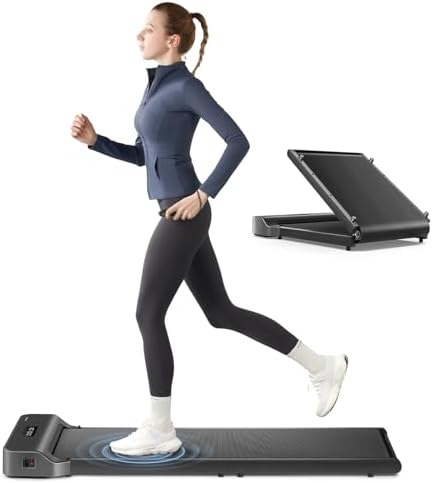
If you strictly want 2.0 to 3.2 mph steps during Zoom calls and zero running, skip unvetted $150 clones that sparked CPSC overheating warnings [15].
The fold-in-half WalkingPad P1 tucks under a sofa, skips bulky upright masts, and holds a proven multi-year track record in Garage Gym Reviews long-term office testing [5].
How we researched this
I built these pass-or-fail rules through November 2026 by pulling actual owner manuals, wiring diagrams, and warranty fine print across 15 home treadmill brands, including NordicTrack, Horizon Fitness, Sole, Peloton, BowFlex, True Fitness, Spirit, and Urevo [2] [4] [18].
For room safety and wiring rules, we matched manufacturer install sheets against ASTM F2115-12 rear-clearance standards [1], Horizon technical support electrical requirements [2], and federal CPSC recall filings from 2021 through 2026 [14] [15].
For joint impact and uphill muscle recruitment numbers, we relied on peer-reviewed biomechanics studies indexed in PubMed rather than brand marketing claims [9] [10], and we verified pre-tax HSA and FSA rules directly against September 2026 IRS Section 213 guidance [17].
Every hardware floor in this guide, including the 50-pound weight buffer and 2.25-inch roller minimum, aims for 7 to 10 years of trouble-free home use [7] [8].
Floor framing and electrical codes vary by city and house age, so check with a licensed electrician or building manager if your room setup looks borderline.
Frequently asked questions
What horsepower do I need for a home treadmill?
2.5 to 3.0 continuous horsepower (CHP) is the minimum for most homes. Daily walkers under 180 pounds can use 2.0 to 2.5 CHP, while regular runners need at least 3.0 CHP. Add 0.5 CHP if you weigh over 200 pounds. Ignore peak horsepower numbers because motors cannot sustain them.
How much ceiling height do I need for a treadmill at home?
Add 15 to 20 inches to your bare height. Combine the treadmill step-up height (usually 8 to 10 inches), your height in shoes, 4 inches for running bounce, and 3 inches if you use steep incline. A 6-foot runner on a 9-inch deck needs at least an 8-foot ceiling.
Does a home treadmill need a dedicated electrical circuit?
Yes. Most motorized treadmills require a dedicated 15-amp or 20-amp grounded outlet that is not shared with major appliances. Avoid plugging treadmills into extension cords, surge strips, or sensitive GFCI garage and basement outlets, which frequently trip from normal motor speed controller interference and can damage electronics.
Do smart treadmills work without a monthly subscription?
Yes, in basic manual mode. Treadmills locked to platforms like iFIT or Peloton still let you adjust speed and incline manually if you cancel the 39 to 50 dollar monthly plan. However, you lose guided classes, automatic terrain adjustments, workout history, and often built-in video streaming apps.
Can I put a treadmill in an unheated garage or upstairs apartment?
Usually no for unheated garages, and only for walking upstairs. Most manufacturers void electronics warranties if you keep a treadmill in an unheated garage due to moisture, dust, and freezing temperatures. In upstairs apartments, walking on a thick rubber mat works well, while running sends heavy vibrations downstairs.
What belt size should I look for when buying a treadmill for home?
Look for a belt at least 20 inches wide and 55 inches long for jogging or running. Walkers can use an 18-by-50-inch belt safely. If you are 6 feet tall or run faster than 8 miles per hour, choose a 20-by-60-inch or 22-by-60-inch belt so your stride stays safe.
Can I buy a home treadmill with HSA or FSA funds?
Yes, with a Letter of Medical Necessity from a licensed healthcare provider. If a doctor prescribes regular cardiovascular exercise to treat or prevent a specific condition such as hypertension, diabetes, obesity, or joint rehabilitation, your HSA or FSA administrator can approve pre-tax payment or reimbursement, saving 25 to 35 percent.
Citations
- [1] Home Gym Specs (citing ASTM F2115-12) – “Folding Treadmill Placement: Space to Run, Fold, and Store” – 2025
- [2] Horizon Fitness Support – “Treadmill Belt Does Not Move or Moves Briefly” – 2026
- [3] Sparnod Fitness – “Home Treadmill Buying Guide: What Fitness Experts Won’t Mention” – 2025
- [4] NordicTrack – “NordicTrack X24 Bike Review: Price, Specs & Warranty” – 2026
- [5] Garage Gym Reviews – “The Ultimate Treadmill Buying Guide (2026)” – 2026
- [6] RitFit Sports – “Best Treadmill for Home Use in 2026” – 2026
- [7] TreadmillReviews.net – “Five Step Treadmill Buying Guide” – January 25, 2025
- [8] Verywell Fit – “How to Choose a Treadmill: Motor, Cost, and More Specs” – 2025
- [9] Sports Medicine (Van Hooren et al.) – “Is Motorized Treadmill Running Biomechanically Comparable to Overground Running? A Systematic Review and Meta-Analysis of Cross-Over Studies” – April 2020 – https://doi.org/10.1007/s40279-019-01237-z
- [10] Gait & Posture (Franz & Kram) – “The effects of grade and speed on leg muscle activations during walking” – January 2012 – https://doi.org/10.1016/j.gaitpost.2011.08.025
- [11] Runner’s World – “The 8 Best Treadmills in 2026” – 2026
- [12] iFIT – “iFIT Membership | Workout App Plans & Features” – 2026
- [13] Peloton Support – “Peloton App Memberships vs. Peloton All-Access Membership” – 2026
- [14] U.S. Consumer Product Safety Commission – “Peloton Agrees to Pay $19 Million Civil Penalty for Failure to Immediately Report Tread+ Treadmill Entrapment Hazards” – January 5, 2023
- [15] U.S. Consumer Product Safety Commission – “CPSC Warns Consumers to Stop Using Sperax Walking Pads and Treadmills Immediately” – 2026
- [16] Consumer Reports – “Treadmill Buying Guide” – 2026
- [17] Internal Revenue Service – “Frequently asked questions about medical expenses related to nutrition, wellness, and general health” – September 23, 2026
- [18] NYT Wirecutter – “The 2 Best Treadmills of 2026” – 2026
- [19] Horizon Fitness – “Horizon 7.0 AT Treadmill Specifications” – 2026
- [20] Garage Gym Reviews – “Expert-Tested: Sole F80 Treadmill Review (2026)” – 2026
- [21] TreadmillReviews.net – “NordicTrack Commercial 1750 Comparison & Specs (2026)” – 2026
- [22] BowFlex – “BowFlex T9 Treadmill Specifications” – 2026
- [23] Sole Treadmills (Spirit Comparison) – “SOLE F80 vs Spirit XT385 Treadmill: Differences, Specs & Price” – 2026
