
For 90% of your cooking, a tri-ply stainless steel pan delivers the best results. You can sear, saute, and build fond without worrying about coatings or temperature limits.
For eggs, fish, and delicate proteins, you need a ceramic nonstick pan. This combination covers everything.
I tested pans across three categories:
- The egg slide test
- The steak sear test, and
- Heat retention.
The winners balanced professional performance with modern aesthetics.
Some “Instagram-famous” pans disappointed in the kitchen. Others looked industrial but cooked beautifully. The best cooking pans sit somewhere in between.
Here Are My Top Picks:



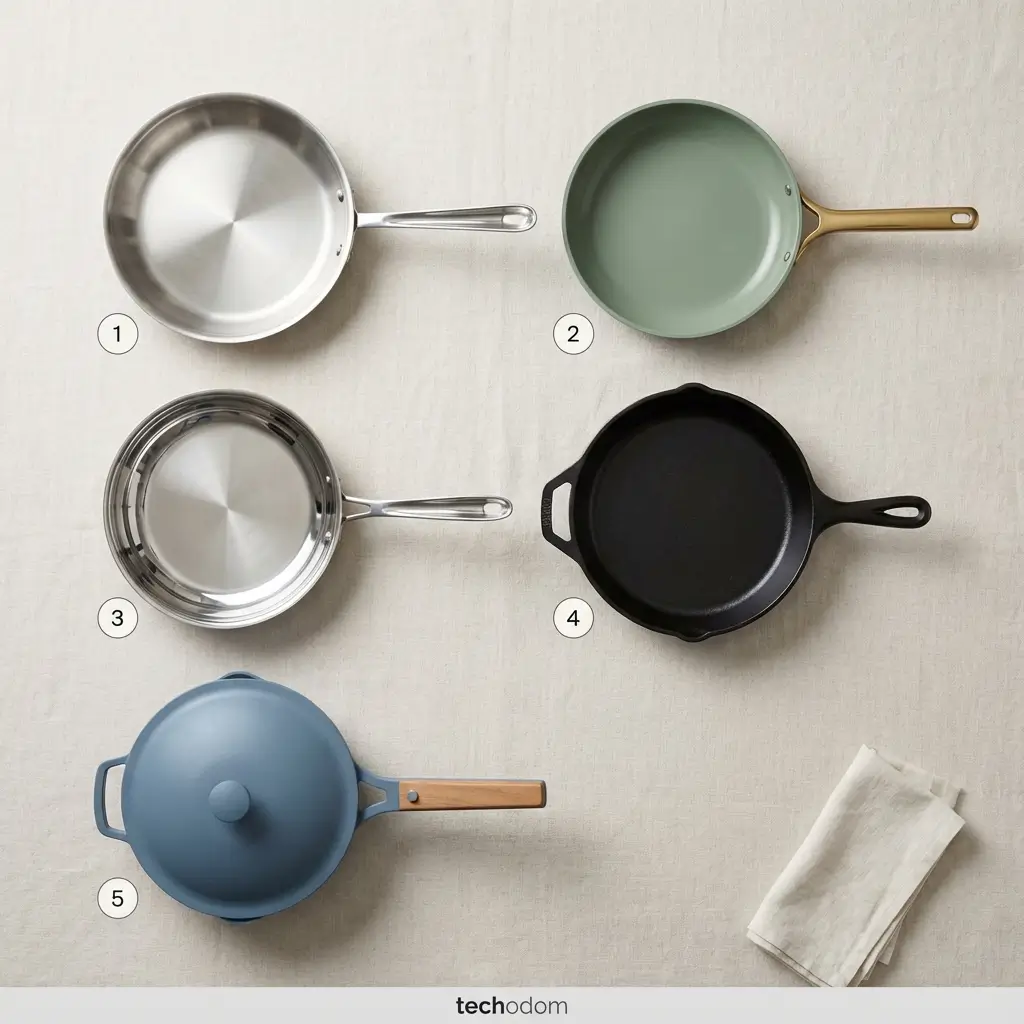
| Brand | Material | Max Oven Temp | Induction Safe | Price | Vibe |
|---|---|---|---|---|---|
| All-Clad D3 | Tri-ply stainless | 600°F | Yes | $150 | Professional |
| Caraway | Ceramic nonstick | 550°F | Yes | $95 | Modern Boho |
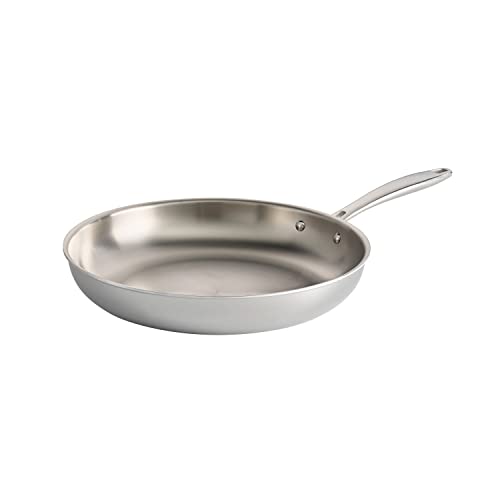
| Tramontina | Tri-ply stainless | 500°F | Yes | $45 | Budget Pro |
| Lodge Cast Iron | Cast iron | Unlimited | Yes | $30 | Farmhouse |
| Our Place Always Pan | Ceramic nonstick | 450°F | Yes | $135 | Minimalist |
Things To Keep in Mind Before You Buy
- Stainless steel lasts decades. Tri-ply construction resists warping and delivers even heat distribution. Buy once, cook forever.
- Ceramic nonstick wears out in 1 to 3 years. Quality brands like Caraway and GreenPan extend this lifespan with proper care, but the coating degrades regardless [1].
- Cast iron requires maintenance but rewards you. Season it correctly, and you get natural nonstick properties without chemicals.
- “Always Pans” are great for serving, not searing. The Our Place Always Pan 2.0 works well at medium heat. High heat performance suffers [2].
- Ply count affects heat distribution. 3-ply (tri-ply) pans heat faster and more evenly than single-layer stainless. 5-ply adds weight without proportional benefit.
- Metal utensils damage all nonstick coatings. Even brands claiming “metal-safe” coatings show wear after repeated use. Use silicone or wood.
The 5 Best Cooking Pans by Category
1. Best Overall (The Workhorse): All-Clad D3 Stainless Steel 12-Inch Skillet
The All-Clad D3 remains the industry standard for professional and home cooks. Three layers of bonded metal (stainless steel, aluminum core, stainless steel) deliver superior heat distribution. Wirecutter calls it a “proven workhorse with superior heat conduction” [3].
You can sear a ribeye, deglaze with wine, and transfer directly to a 500°F oven. The pan handles abuse. I have used my personal D3 for eight years without warping. The brushed stainless exterior looks professional without shouting for attention.
Tri-ply construction, oven safe to 600°F, dishwasher safe (hand wash recommended), induction compatible, 2.5 lbs.
Best For: Searing, sauteing, pan sauces, and oven-finishing

2. Best Aesthetic & Non-Toxic: Caraway Ceramic Cookware Set
Caraway dominated Pinterest for good reason. The muted color palette (Sage, Cream, Navy, Perracotta) looks stunning. The ceramic coating releases eggs without butter. The included storage rack solves cabinet chaos.
Why I Recommend It: Caraway pans are free of PTFE, PFOA, PFAS, lead, and cadmium [4]. If non-toxic cookware matters to your family, this brand delivers peace of mind. The slick surface performs beautifully at low to medium heat.
Just keep in mind that High heat damages the ceramic coating.
Caraway states their pans handle up to 550°F, but repeated high-heat use shortens lifespan. Expect 1 to 3 years of nonstick performance with typical home use [1].
● Specs: Ceramic nonstick coating, oven safe to 550°F, PFOA-free, hand wash only, induction compatible.
● Best For: Low-fat cooking, health-conscious households, kitchen decor.
3. Best Budget Value: Tramontina Tri-Ply Clad 12-Inch Skillet
Serious Eats tested Tramontina against All-Clad in head-to-head comparisons. Their verdict? “Performance-wise, the Tramontina pan was fairly identical to the All-Clad” [5]. The Tramontina actually showed slightly better heat retention in controlled tests.
● Why I Recommend It: You get 90% of premium performance for 30% of the price. The Tramontina uses the same tri-ply construction with an aluminum core sandwiched between stainless steel layers. Wirecutter named the Tramontina set their top pick for cookware in 2025 [6].
● Specs: Tri-ply construction, oven safe to 500°F, dishwasher safe, induction compatible, made in Brazil/China.
● Best For: Home cooks who want All-Clad performance at a lower price Price: Approximately $45
4. Best Cast Iron (Heritage Choice): Lodge 12-Inch Cast Iron Skillet
The Lodge Cast Iron Skillet costs less than a dinner for two but lasts generations. Serious Eats calls it the best cast iron skillet overall, noting it “heats up fast and sears deeply” [7].
● Best For: Searing steaks, cornbread, stovetop-to-oven cooking Price: Approximately $25 to $35
● Why I Recommend It: Cast iron is naturally non-toxic. No coatings to peel. No chemicals to worry about. With proper seasoning, eggs slide off just like nonstick. The pan weighs about 8 pounds, which builds excellent heat retention for searing.
● Specs: Pre-seasoned, oven safe to any temperature, dishwasher safe (not recommended), induction compatible, 8 lbs.
5. Best Multifunction (The Minimalist): Our Place Always Pan 2.0

The Always Pan 2.0 replaces multiple tools. It functions as a frying pan, saute pan, steamer, skillet, saucier, and spoon rest. The 2.0 version is oven safe up to 450°F, an upgrade from the original [2].
● Best For: Small kitchens, minimalist cooks, serving at the table
● Why I Recommend It: If you want one pan that does most things adequately, this works. The ceramic coating releases food easily. The included steamer basket adds versatility. The colors (Steam, Sage, Char) match the Caraway aesthetic.
● Warning: The Kitchn review notes “it lacks the heat retention needed for effective searing” at high temperatures [8]. This pan excels at medium-heat cooking. Do not expect steakhouse-quality sears.
● Specs: Ceramic nonstick coating, oven safe to 450°F, PFOA-free, hand wash only, induction compatible, 3 lbs with lid.
The Material Breakdown You Need to Know
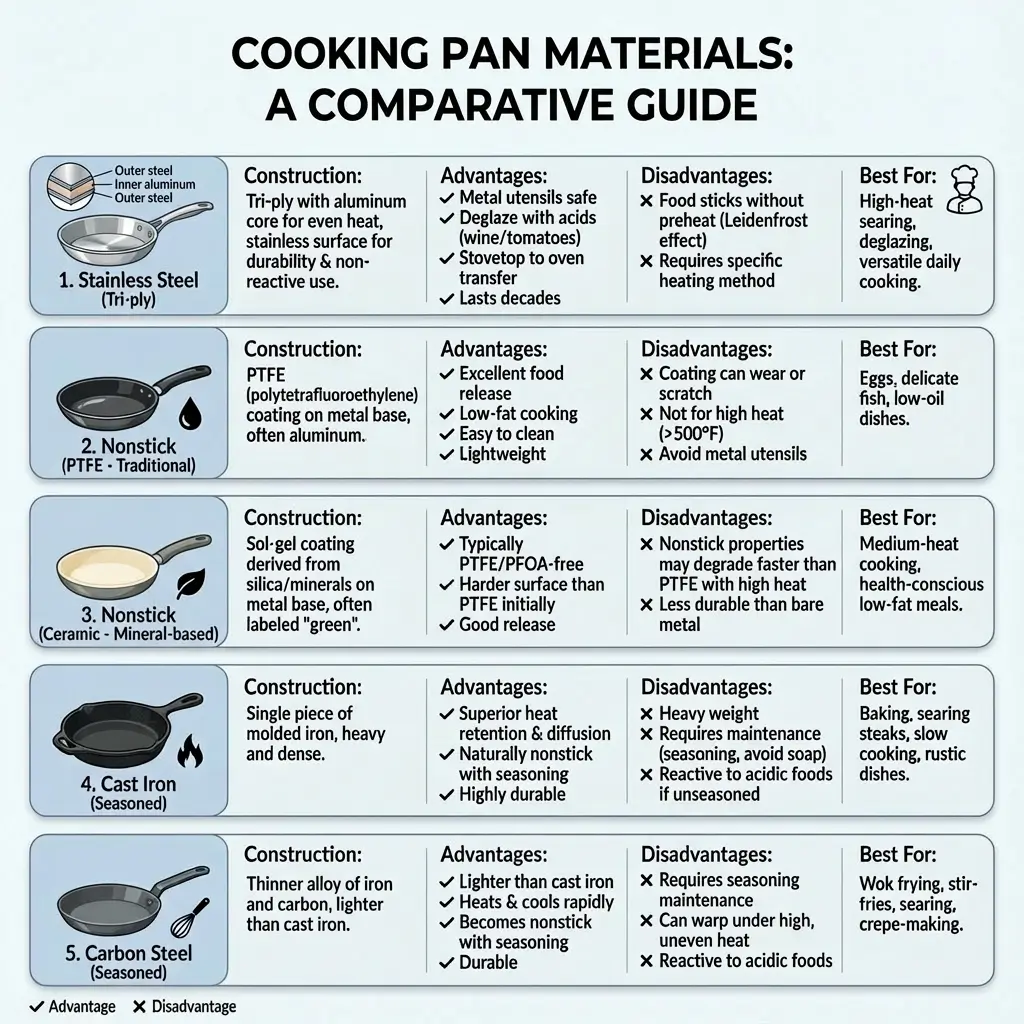
Choosing a pan starts with choosing a material. Each has trade-offs. Understanding them helps you make smarter purchases.
Stainless Steel: The Pro Choice
Tri-ply stainless steel sandwiches an aluminum core between two stainless steel layers. The aluminum conducts heat quickly and evenly. The stainless steel provides durability and a non-reactive cooking surface.
- Advantages: You can use metal utensils. You can deglaze with acidic liquids like wine or tomatoes. You can transfer from stovetop to oven without restrictions. The pan lasts decades with basic care.
- Disadvantages: Food sticks if you skip the preheat step. You need to heat the pan before adding oil, then heat the oil before adding food. This technique (called the Leidenfrost effect) creates a temporary nonstick surface.
Nonstick: PTFE vs. Ceramic
Traditional nonstick pans use PTFE (polytetrafluoroethylene), commonly known as Teflon. PTFE itself is considered safe, but manufacturers previously used PFOA in production. PFOA has been classified as “carcinogenic to humans” by the International Agency for Research on Cancer [9].
Modern PTFE pans in the United States are made without PFOA. However, other PFAS chemicals remain in some nonstick coatings [10].
Ceramic nonstick uses a silica-based coating. Brands like Caraway, GreenPan, and Our Place market their products as PTFE-free, PFOA-free, and PFAS-free [4]. The ceramic surface releases food without requiring much oil.
The Trade-off: Ceramic coatings degrade faster than PTFE. Most ceramic pans lose nonstick properties within 1 to 3 years, compared to 3 to 5 years for quality PTFE pans [1]. You trade chemical concerns for shorter lifespan.
Cast Iron and Carbon Steel: For the Sear Enthusiasts
Cast iron holds heat better than any other common cookware material. This makes it ideal for high-heat searing, where you want the pan to maintain temperature when cold meat hits the surface.
Carbon steel offers similar performance with less weight. Professional chefs often prefer carbon steel for its responsiveness. Both materials require seasoning (building up thin layers of polymerized oil) to maintain nonstick properties.
Maintenance Reality: Cast iron requires hand washing, immediate drying, and occasional re-seasoning. Some users find this process enjoyable. Others find it tedious. Know yourself before committing.
Ply Count and Cladding Explained
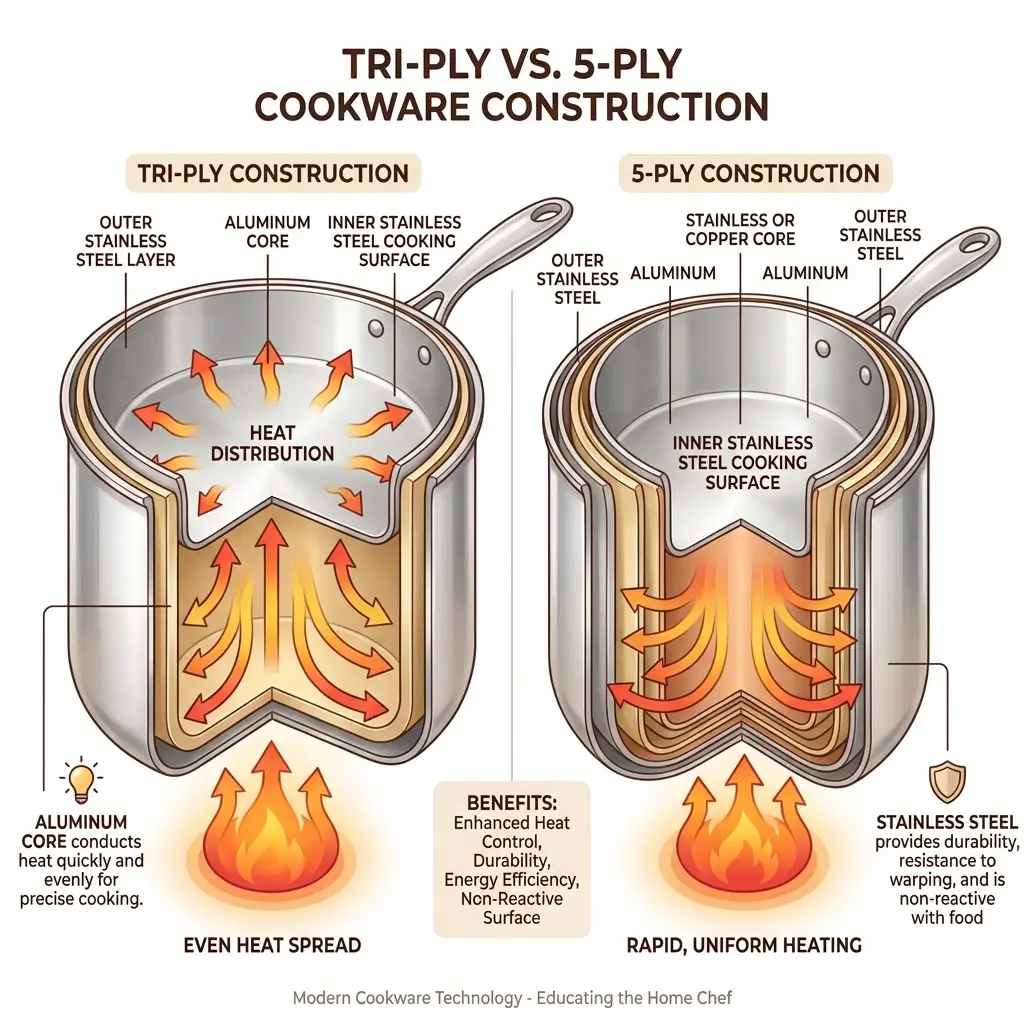
“Tri-ply” means three layers. “5-ply” means five layers. The term “fully clad” means the layers extend up the sides of the pan, not just the bottom.
Fully clad construction matters. Pans with multi-layer bottoms but single-layer sides (called encapsulated or disc-bottom pans) develop hot spots where the sides meet the base [6].
How Tri-Ply Works
The aluminum core in a tri-ply pan distributes heat laterally. When your burner heats the center, the aluminum spreads that heat outward. This reduces hot spots and promotes even browning.
Serious Eats tested All-Clad and Tramontina skillets by browning flour on their surfaces. Both pans showed relatively even browning patterns, with All-Clad showing slightly better distribution [5].
Does 5-Ply Perform Better?
In most home cooking scenarios, no. Wirecutter’s testing found that 5-ply cookware “took longer to heat up, didn’t heat as uniformly as tri-ply cookware, and was heavier” [6]. The extra layers add weight without proportional benefit for most tasks.
5-ply pans retain heat longer, which can be useful for specific techniques. But for everyday cooking, tri-ply delivers the best balance of performance, weight, and price.
Handle Ergonomics and Weight
A pan you cannot lift comfortably is a pan you will not enjoy using. Weight and handle design matter more than most buyers realize.
Weight Guidelines
Wirecutter’s testing found that most testers preferred skillets weighing between 2 and 3.5 pounds [6]. This range allows comfortable one-handed tossing and maneuvering without excessive wrist strain.
Cast iron breaks this rule deliberately. An 8-pound pan builds heat retention. You trade maneuverability for searing performance.
Handle Heat
Some stainless steel pans have handles that conduct heat from the cooking surface. All-Clad handles stay relatively cool during stovetop use but get hot in the oven [11]. Always use pot holders when retrieving any pan from the oven.
The Our Place Always Pan uses a “stay-cool” handle design. In testing, the handle remained comfortable during normal stovetop cooking [2].
What I Like and Don’t Like
Stainless Steel (All-Clad D3, Tramontina)
- What I Like: Stainless steel sears meat beautifully. The fond (browned bits stuck to the pan) creates rich pan sauces. You can deglaze with wine without worrying about coating damage. Most stainless steel pans are technically dishwasher safe, though hand washing extends their appearance.
- What I Don’t Like: Food sticks if you skip proper preheating. The Leidenfrost effect requires heating the pan first, adding oil, then adding food. This learning curve frustrates some new users. Eggs and fish present challenges without sufficient fat.
Ceramic Nonstick (Caraway, Our Place)
- What I Like: Eggs slide off like magic. You need minimal oil for cooking. The matte colors look beautiful in any kitchen. Cleanup takes seconds. These pans work well for health-conscious cooks reducing fat intake.
- What I Don’t Like: The coating wears faster than any other material. Users commonly report losing nonstick properties after 6 to 18 months of regular use [1]. High heat accelerates degradation. You will replace ceramic nonstick pans more frequently than stainless steel.
Cast Iron (Lodge)
- What I Like: Cast iron lasts forever. With proper seasoning, you get natural nonstick properties. The pan handles extreme heat without damage. Price per year of use approaches zero.
- What I Don’t Like: Weight limits usability for some cooks. Reactive surfaces require avoiding acidic foods during initial seasoning. Maintenance (hand wash, dry immediately, oil lightly) adds friction to the cooking routine.
Real User Complaints You Should Know
Before buying, consider what actual users report after months of ownership. I analyzed reviews across Amazon, Reddit, and cookware forums to identify recurring issues.
The “Sticky” Truth About Ceramic
Ceramic nonstick pans receive frequent complaints about losing nonstick properties. One Reddit user reported their ceramic pan became “just a regular pan” after 3 to 4 months [12]. This aligns with industry data showing ceramic coatings degrade faster than PTFE alternatives.
→ Save-worthy tip: Use only low to medium heat with ceramic pans. High heat damages the coating irreversibly. Caraway specifically warns against high-heat cooking in their care instructions [4].
The Weight Issue With 5-Ply
Users frequently mention wrist strain with heavier cookware. Some 5-ply copper-core pans weigh over 4 pounds. For cooks with arthritis or wrist issues, this weight becomes prohibitive.
The Handle Heat Problem
Several All-Clad users report handles getting hot during extended stovetop cooking. One Eater comparison noted, “the handle of All-Clad saute pans can get hot pretty quickly” [11]. Keep a side towel nearby.
The Power Couple Approach
You do not need 12 pans. You need two good ones.
- Your first pan: A tri-ply stainless steel skillet (All-Clad D3 or Tramontina). This handles 80% of cooking tasks. It sears, sautees, braises, and lasts decades.
- Your second pan: A ceramic nonstick pan (Caraway or GreenPan). Reserve this for eggs, fish, and delicate proteins. Accept that you will replace it every 2 to 3 years.
- Optional third: A Lodge cast iron skillet for steaks, cornbread, and stovetop-to-oven dishes.
This three-pan setup covers virtually every home cooking scenario. Your kitchen looks clean. Your cookware performs. Your wallet recovers.
FAQ
- [1] Made In Cookware, “How Long Do Ceramic Pans Actually Last?”, August 2024, https://madeincookware.com/blogs/how-long-do-ceramic-pans-last
- [2] Bon Appetit, “Our Place Always Pan 2.0 Review”, December 2025, https://www.bonappetit.com/story/our-place-always-pan-2-review
- [3] New York Times Wirecutter, “The Best Stainless Steel Pans & Skillets of 2026”, February 2025, https://www.nytimes.com/wirecutter/reviews/the-best-skillet/
- [4] Caraway Home, “Best Ceramic Cookware Set”, https://www.carawayhome.com/products/cookware-sets
- [5] Serious Eats, “All-Clad vs. Tramontina: Which is the Better Skillet?”, https://www.seriouseats.com/equipment-the-all-clad-vs-tramontina-skillet
- [6] New York Times Wirecutter, “The 3 Best Cookware Sets of 2026”, November 2025, https://www.nytimes.com/wirecutter/reviews/best-cookware-set/
- [7] Serious Eats, “The 6 Best Cast Iron Skillets of 2026”, https://www.seriouseats.com/best-cast-iron-skillet
- [8] The Kitchn, “My Honest Review of Always Pan 2.0 for 2026”, December 2025, https://www.thekitchn.com/always-pan-review-23761199
- [9] American Cancer Society, “PFOA, PFOS, and Related PFAS Chemicals”, May 2024, https://www.cancer.org/cancer/risk-prevention/chemicals/teflon-and-perfluorooctanoic-acid-pfoa.html
- [10] America’s Test Kitchen, “Are Nonstick Pans Safe?”, October 2023, https://www.americastestkitchen.com/articles/7586-are-nonstick-pans-skillets-safe-toxic
- [11] Eater, “Made In vs. All-Clad: Which Stainless Steel Set Is Better?”, May 2025, https://www.eater.com/24427087/made-in-vs-all-clad-stainless-steel-cookware
- [12] Reddit r/AskCulinary, “Do all ceramic pans have this short life span?”, July 2019, https://www.reddit.com/r/AskCulinary/comments/cbdnqg/do_all_ceramic_pans_have_this_short_life_span/
- [13] Sur La Table, “Avoid These 12 Stainless Steel Cookware Mistakes”, February 2024, https://learn.surlatable.com/how-to-make-stainless-steel-cookware-last/
Techodom's mission is to surface the most useful, expert recommendations for things to buy in the vast e-commerce landscape. We try to update the links as often as possible, but please note that deals may expire and all prices may change. Each editorial product is independently selected and reviewed. Techodom may earn a commission if you make a purchase through one of our links.
